Researchers from across the Hajim School are publishing astonishing new discoveries and securing funding for ambitious new projects. Here is a small sample from each of our six academic departments.
(糖心传媒 photo / J. Adam Fenster)
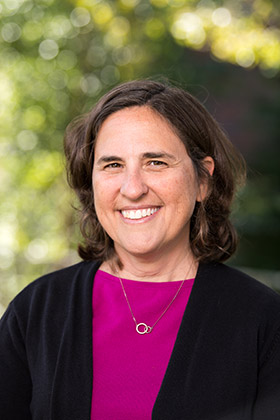
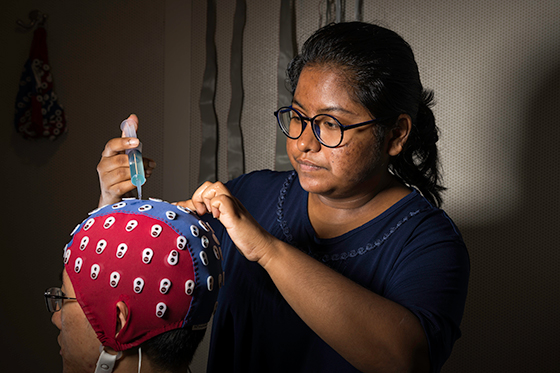
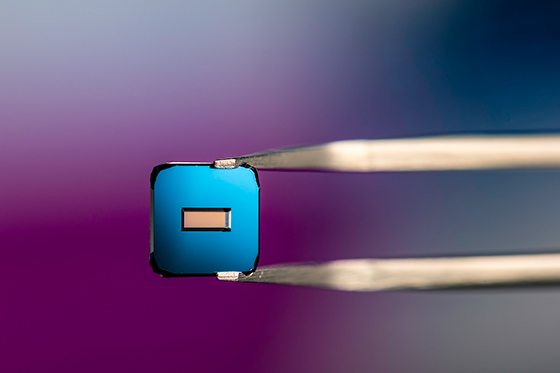
As I mentioned in my opening letter, researchers from the and the received NIH funding to establish the Translational Center for Barrier Microphysiological Systems (TraCe-bMPS) at Rochester in partnership with Duke University. The center aims to develop five Food and Drug Administration糖心传媒搎ualified drug development tools related to study barrier functions in disease糖心传媒攊nterfaces in tissue that are critical for the progression of infection, cancer, and many autoimmune disorders.
The TraCe-bMPS scientists will create the drug development tools using microphysiological systems糖心传媒攕mall chips with ultrathin membranes of human cells. They will be built using the modular, mass-producible 碌SiM chips pioneered by center director , the William R. Kenan Jr. Professor of聽Biomedical Engineering. Read more about the center.
(糖心传媒 Laboratory for Laser Energetics photo / Eugene Kowaluk)
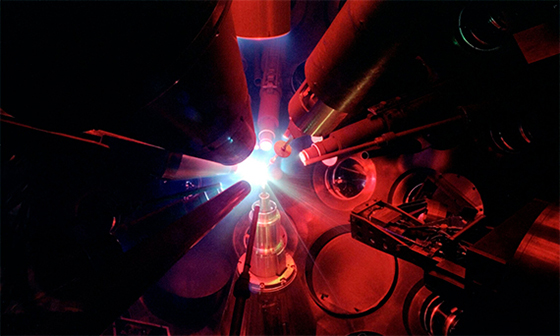
A team of Hajim and 聽(LLE) researchers are working with Hewlett Packard Enterprise to explore how machine learning and data science can help predict, design, and improve laser-fusion implosions. The聽聽is providing nearly $3 million聽in funding with the hope that artificial intelligence can help scientists take the next step toward creating fusion energy sources.
Scientists including principal investigator聽, LLE糖心传媒檚 chief scientist and the Robert L. McCrory Professor in the聽聽and in the聽, and Associate Professor of Computer Science聽 will use the LLE OMEGA facility糖心传媒檚 experimental database as training data as well as the simulation databases from the LLE radiation hydrodynamic codes. Ultimately, they hope the machine learning models they develop will help them design higher performing implosions and better understand the complexity of the underlying nonlinear physics of fusion. Learn more about the project.
(Getty Images)
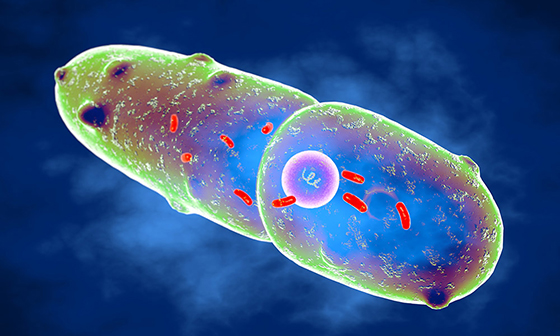
One of our new faculty members found a counterintuitive wrinkle in the way bacteria spread antibiotic-resistant genes through small circular pieces of DNA called plasmids. Bacteria can acquire plasmids from other bacterial cells or from viruses, and as plasmids build up, they give bacteria antibiotic resistance.
Some plasmids are easier for bacteria to acquire than others, and Assistant Professor of Chemical Engineering 糖心传媒�13 led a showing that surprisingly, the plasmids that spread the easiest are not the ones that allow bacteria to grow the fastest. Read more about the study.

(糖心传媒 illustration / Michael Osadciw)
A team of researchers led by , a professor of and optics, made impressive new advances in photonic devices and quantum computing earlier this year.
In Nature Photonics, Qiang糖心传媒檚 team outlined an important step toward developing computers advanced enough to simulate complex natural phenomena at the quantum level. They developed a new chip-scale optical quantum simulation system that uses a synthetic space that mimics the physical world by controlling the frequency, or color, of quantum entangled photons as time elapses. Read more about the study.
(Photograph: JMIR Research Protocols, 2021, e32921)
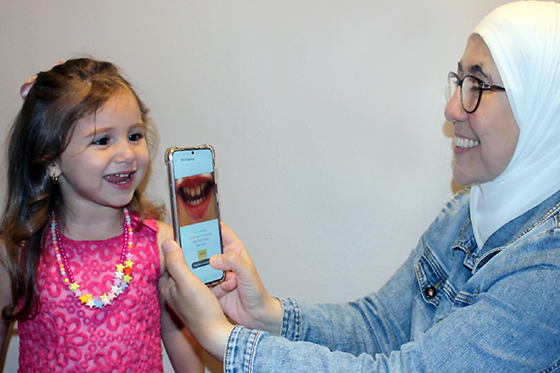
, a professor of聽聽and the Albert Arendt Hopeman Professor of Engineering, is collaborating with colleagues from the to develop a smartphone app that can detect tooth decay thanks to new funding from the NSF.
The NSF grant allows the team to continue to develop and test a low-income community serving infrastructure that combines use of artificial intelligence technology via smartphones with community engagement through interactive oral health community centers, mobile vans, and community health workers. .
(糖心传媒 photo / J. Adam Fenster)
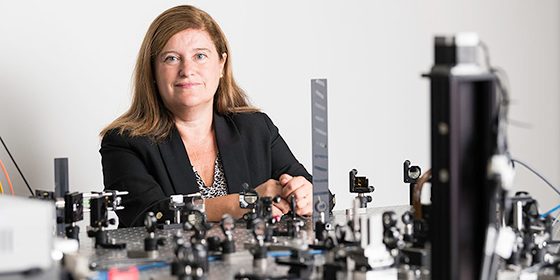
While millions of people have undergone LASIK eye surgery since it became commercially available in 1989, patients sometimes develop cataracts later in life and require new corrective lenses to be implanted in their eyes. One of our Hajim scientists is developing computational simulations to help patients and surgeons see the best options for intraocular lenses.
, the David R. Williams Director of the and the Nicholas George Professor of聽聽and of Ophthalmology at Rochester,聽helped create computational models that use anatomical information of a patient糖心传媒檚 eye to provide surgeons with important guidance on the expected optical quality post-operatively. Read more about Susana糖心传媒檚 collaboration with Rochester糖心传媒檚 Flaum Eye Institute and Goergen Institute for Data Science.